ZuriQ-founding team drives breakthrough in single-ion electromagnetic field detection
Zürich, Switzerland - 08 July 2026; A new peer-reviewed paper from the group of Prof. Jonathan Home at ETH Zürich has just been published in Science Advances, and we at ZuriQ could not be more excited to share it. Here's a little bit about why it matters to us.
The paper shows how a single trapped ion can be used as an ultra-sensitive electromagnetic field detector, making it possible to build high-resolution, three-dimensional maps of both static fields and dynamic noise around ion-trap chips. These measurements give us a powerful new tool for characterizing chip materials, pinpointing sources of electrical and magnetic noise, and ultimately improving the performance of future quantum computers.
Using the Penning micro-trap technology that is at the heart of ZuriQ's quantum computing systems, the team cooled a single beryllium ion to its lowest quantum mechanical oscillation state and positioned it at points ranging from 50 to 450 micrometers above the chip surface, scanning an area of 200 by 200 micrometers. At each point, the ion's motion and position reveals how strongly it's being disturbed by electric fields on the chip, letting the team build up a full three-dimensional map of both static fields and oscillating noise across the chip's surface. The technique proved remarkably sensitive: it set a new record for this type of measurement, detecting oscillating electric fields as small as 10 nanovolts per meter within a one-second measurement window — a sensitivity thousands of times below the electromagnetic field strength of a mobile phone at a distance of several kilometers.
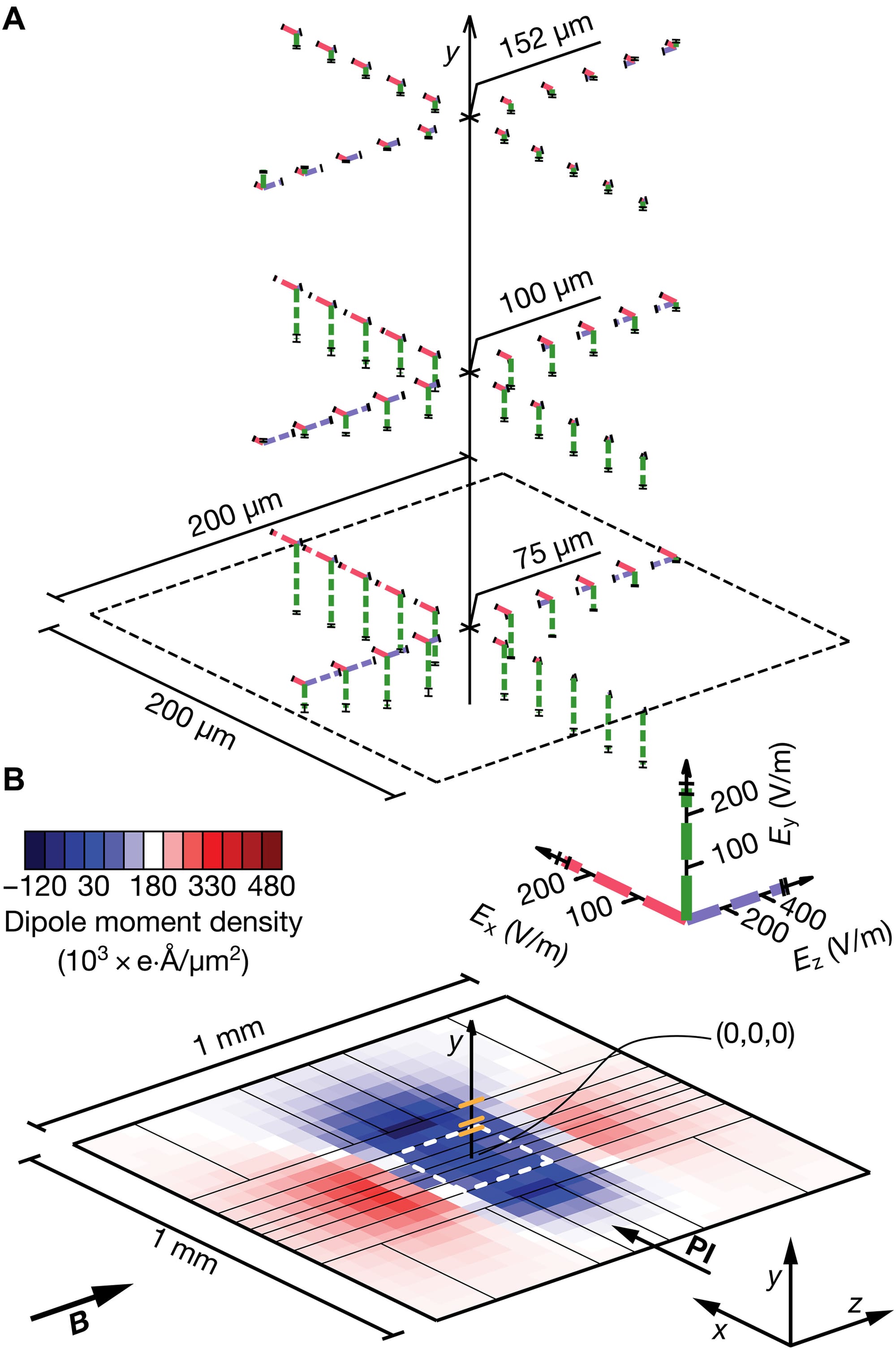
So why are these results so important? Characterising these effects is paramount for effective operations of trapped ion quantum processors. When the ion qubits move around above the surface of trapped ion chips, the presence of undesired static electric field leads to degrade performance as the ions are pushed and tugged by the fields along their trajectories. By creating a 3D map of these fields (Panel A in figure below), we not only can learn how to compensate them, but also use them to reconstruct the charge distribution on the chip surface that give rise to them (Panel B). Understanding the patterns of these charge distributions is essential to learning how to prevent and mitigate such effects in larger processors.
Similarly, noisy electromagnetic fields near a chip's surface are one of the sources of error during qubit operations and taming them will be the difference between today's devices and the larger, more reliable quantum processors of tomorrow. Being able to map these noisy fields in 3D with this level of precision gives us a real tool for characterizing chip materials, testing the theoretical models that predict the noise patterns, tracking down sources of noise, and pushing gate fidelities higher.
That's exactly the kind of deep scientific understanding we're building on as we develop our own utility-scale quantum computer, based on a native two-dimensional Penning-trap architecture that uses static electromagnetic fields rather than the oscillating radio-frequency fields found in conventional ion traps.
This work is close to home for us. ZuriQ's founders contributed to this research during their time in Home's group at ETH Zürich, and it reflects the same scientific groundwork that shaped ZuriQ from the start. Our CTO Tobias Saegesser led the effort, alongside Shreyans Jain and the rest of the team — and we couldn't be prouder to see it reach publication.
Further reading
- Feature coverage from The Quantum Insider: https://thequantuminsider.com/2026/07/02/single-ion-detector-could-lead-to-improvements-in-quantum-computers-and-sensors/
- Full peer-reviewed paper in Science Advances: https://www.science.org/doi/10.1126/sciadv.aec0794
