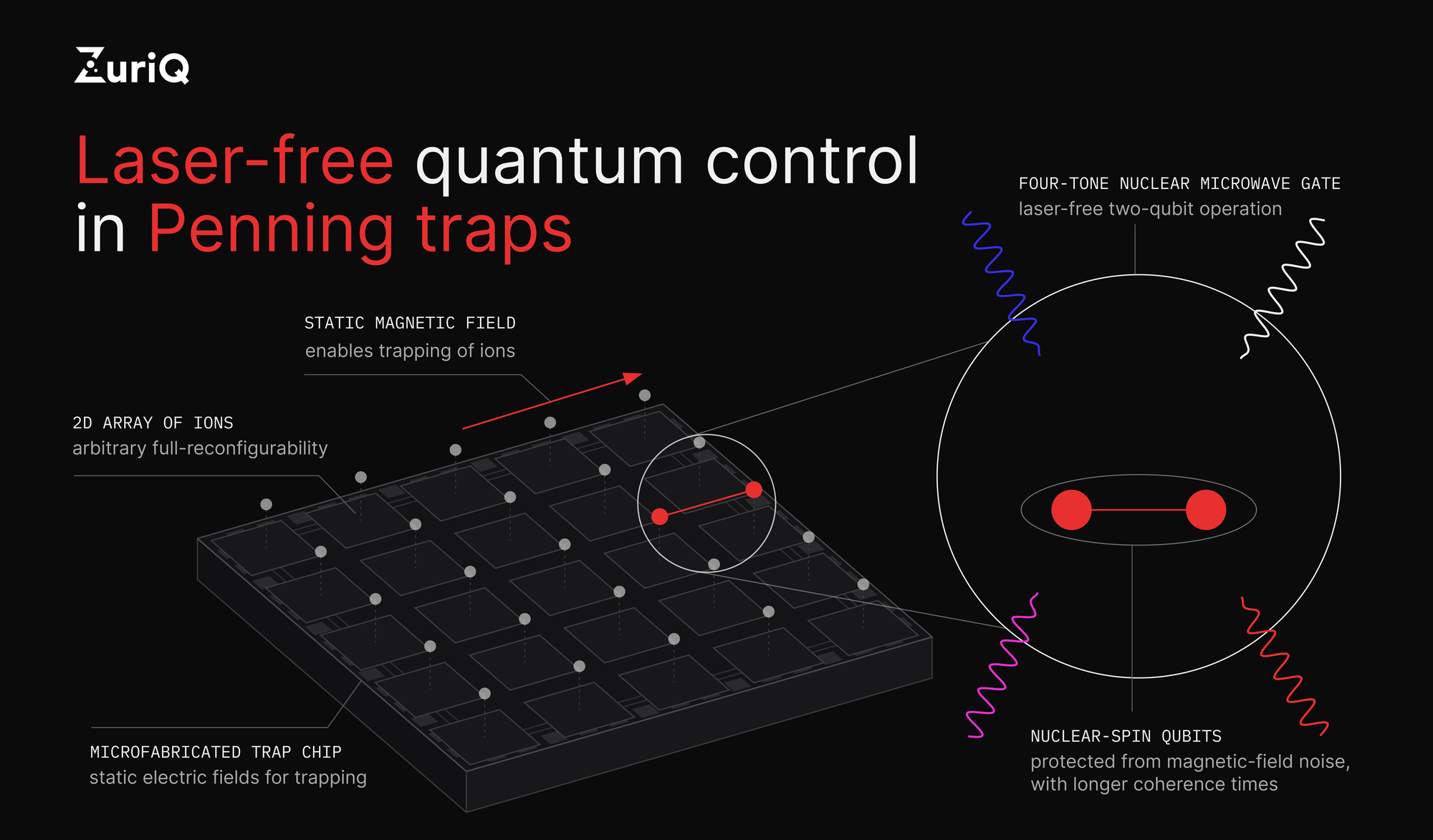
A new paper from the team of Prof. Jonathan Home at ETH Zürich, our co-founder and scientific advisor, in collaboration with ZuriQ presents a new approach to controlling nuclear-spin qubits in high magnetic field Penning traps.
The Penning trap, through its combination of static magnetic and electric fields, enable ions to be freely rearranged across a two-dimensional array. At the same time, this large magnetic field leads to the emergence of nuclear-spin qubits that are attractive for quantum computing because they are naturally well protected from the decoherence caused by fluctuations in magnetic fields.
The preprint introduces a new microwave-based approach for performing two-qubit operations which leverages their robustness and minimises the reliance on lasers. The researchers show that the proposed gate can achieve operation speeds comparable to those used with electron-spin qubits while retaining the protection against noise provided by encoding information in the nuclear spin.
This result is an important milestone for ZuriQ’s quantum computing architecture as it shows a compatibility with the family of laser-free gate approaches that have emerged as alternative mechanism to achieve very high-fidelity operations.
This work builds on the broader Penning-trap research carried out at ETH Zürich and supports ZuriQ's efforts to develop scalable quantum computers based on reconfigurable two-dimensional ion arrays.
As ZuriQ continues to develop its architecture, advances in qubit control such as these will be an important part of turning the scaling advantages of Penning traps into practical quantum processors.
Read the full paper: A magnetic-field insensitive gate set for trapped-ion nuclear spin qubits
